What's in the Senate permitting deal, and what it could mean for US emissions
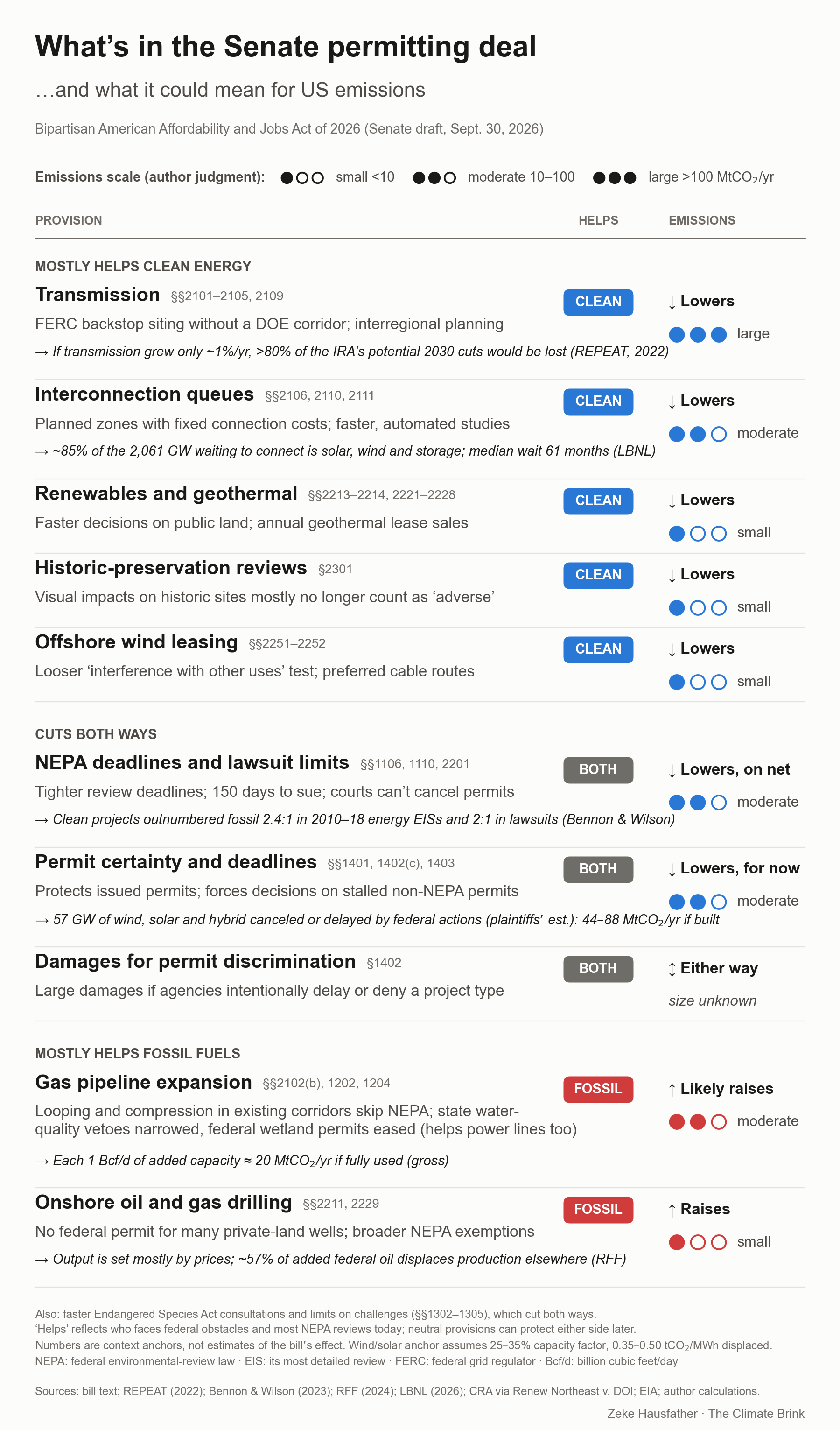
A provision-by-provision scorecard of the Bipartisan American Affordability and Jobs Act of 2026: who each part helps today, and the likely direction and rough scale of its effect on US emissions.
| Provision | What it does | Helps | Emissions |
|---|---|---|---|
| Mostly helps clean energy | |||
| Transmission§§2101–2105, 2109 | FERC backstop siting without a DOE corridor; interregional planning → If transmission grew only ~1%/yr, >80% of the IRA’s potential 2030 cuts would be lost (REPEAT, 2022) source | CLEAN | ↓ Lowerslarge |
| Interconnection queues§§2106, 2110, 2111 | Planned zones with fixed connection costs; faster, automated studies → ~85% of the 2,061 GW waiting to connect is solar, wind and storage; median wait 61 months (LBNL) source | CLEAN | ↓ Lowersmoderate |
| Renewables and geothermal§§2213–2214, 2221–2228 | Faster decisions on public land; annual geothermal lease sales | CLEAN | ↓ Lowerssmall |
| Historic-preservation reviews§2301 | Visual impacts on historic sites mostly no longer count as ‘adverse’ | CLEAN | ↓ Lowerssmall |
| Offshore wind leasing§§2251–2252 | Looser ‘interference with other uses’ test; preferred cable routes | CLEAN | ↓ Lowerssmall |
| Cuts both ways | |||
| NEPA deadlines and lawsuit limits§§1106, 1110, 2201 | Tighter review deadlines; 150 days to sue; courts can’t cancel permits → Clean projects outnumbered fossil 2.4:1 in 2010–18 energy EISs and 2:1 in lawsuits (Bennon & Wilson) source | BOTH | ↓ Lowers, on netmoderate |
| Permit certainty and deadlines§§1401, 1402(c), 1403 | Protects issued permits; forces decisions on stalled non-NEPA permits → 57 GW of wind, solar and hybrid canceled or delayed by federal actions (plaintiffs’ est.): 44–88 MtCO₂/yr if built source | BOTH | ↓ Lowers, for nowmoderate |
| Damages for permit discrimination§1402 | Large damages if agencies intentionally delay or deny a project type | BOTH | ↕ Either wayunknown |
| Mostly helps fossil fuels | |||
| Gas pipeline expansion§§2102(b), 1202, 1204 | Looping and compression in existing corridors skip NEPA; state water-quality vetoes narrowed, federal wetland permits eased (helps power lines too) → Each 1 Bcf/d of added capacity ≈ 20 MtCO₂/yr if fully used (gross) source | FOSSIL | ↑ Likely raisesmoderate |
| Onshore oil and gas drilling§§2211, 2229 | No federal permit for many private-land wells; broader NEPA exemptions → Output is set mostly by prices; ~57% of added federal oil displaces production elsewhere (RFF) source | FOSSIL | ↑ Raisessmall |
Notes
- Scale ratings are the author's qualitative judgments of how much each provision could change US emissions; the bill has not been modeled. Numbers are context anchors, not estimates of the bill's effect.
- 'Helps' reflects who faces federal obstacles and most NEPA reviews today; neutral provisions can protect either side under future administrations.
- Wind/solar anchor assumes a 25-35% capacity factor and 0.35-0.50 tCO2/MWh displaced.
- Also in the bill: faster Endangered Species Act consultations and limits on challenges (secs. 1302-1305), which cut both ways.
- Not in this bill (unlike the 2024 Manchin-Barrasso bill): mandatory oil and gas lease sales, coal leasing, or an LNG-specific export deadline (general permit clocks could still reach DOE). The July 2025 budget law already mandated oil, gas and coal leasing; DOE lifted the LNG export pause in Jan. 2025.
Data
The same table as a CSV file, one row per provision. Please credit Zeke Hausfather, The Climate Brink.
The graphic
Sources
- Bill text (Senate draft, Sept. 30, 2026)
- Princeton REPEAT, transmission and the IRA (2022)
- Bennon & Wilson, NEPA litigation over large energy and transport projects (ELR, 2023)
- LBNL, Queued Up: 2026 edition (interconnection queues)
- Resources for the Future, federal leasing and global emissions (2024)
- Utility Dive on Renew Northeast v. DOI (Apr. 2026)